Madresfield CofE Primary School
Science
"Science is magic that works!" Kurt Vonnegut
What would the world be like if it was not filled with the awe and wonder of the natural world? Without the jewels that we wear so grandly? Without an understanding of space and what lies beyond our universe? Without the knowledge to care for the animals that we all love so dearly. At Madresfield, Scientists are born.
With a curriculum that is designed to ensure that our children can work scientifically, we ignite the awe and wonder of science and allow our children to work practically with the knowledge that they learn. By providing opportunities to design and carry out experiment we pave the way for curious and critical thinkers of the future.
Madresfield's map to proficient scientists
The first step to becoming a successful scientist
- Having a natural curiosity
- Make simple observations
- Notice patterns and changes
- Having opportunities to learn how thinks work
In EYFS, the world is exciting to me! I am desperate to learn how it works. The seasons change as my eyes glisten in the magic, my fingers tingle at the first frost of the year. I ask, why? I roll my car, I notice it stops. Why? My boat doesn't sink like my stone. Why? Everything is new, I use my senses to explore what is around me. How? Why? What if?
I can:
- Explore the natural world around me.
- Describe what I see, hear and feel whilst outside.
- Recognise some environments are different to where I live
- Understand the effect of changing seasons
KS1, the world is less new but it feels more exciting than ever! I've seen the seasons come and go, I've realised that my wellies and coat keep me dry. The objects that are made by humans fascinate me, I'm inspired by the natural world around me. I love sharing my discoveries with my friends, we guess what is going to happen together. Science means team work, science means discovering new things.
I can:
- Ask simple questions and recognise that they can be answered in different ways
- Observe closely, using simple equipment
- Perform simple tests
- Identify and classify
- Use observations and ideas to suggest answers to questions
- Gather and record data to help in answer questions.
I'm in KS2 now and my adults always tell me 'the more you know, the less you know' and that is more true than ever. I thought I knew how the world works but it turns out there is so much more to learn. There are more groups of animals than I realised - where does a platypus even fit in? What type of animal is a jelly fish? Space is, quite literally, a world away from everything that I thought I knew and don't get me started on oobleck - is it a solid or a liquid? I might be older now but I'm still curious, I still find myself asking why (just like when I was 4!)
I can:
- Explore and predict theories
- Test and develop ideas
- Gather data with fair testing
- Draw Conclusions
- Justify my ideas
- Accept that things go wrong and learn from them
It's time for new adventures, Year 7 awaits. A whole new world of discrete biology, chemistry and physics lessons. A chance to continue to ask why, to never stop being curious. I am a scientist and because of that there is so much more to discover!
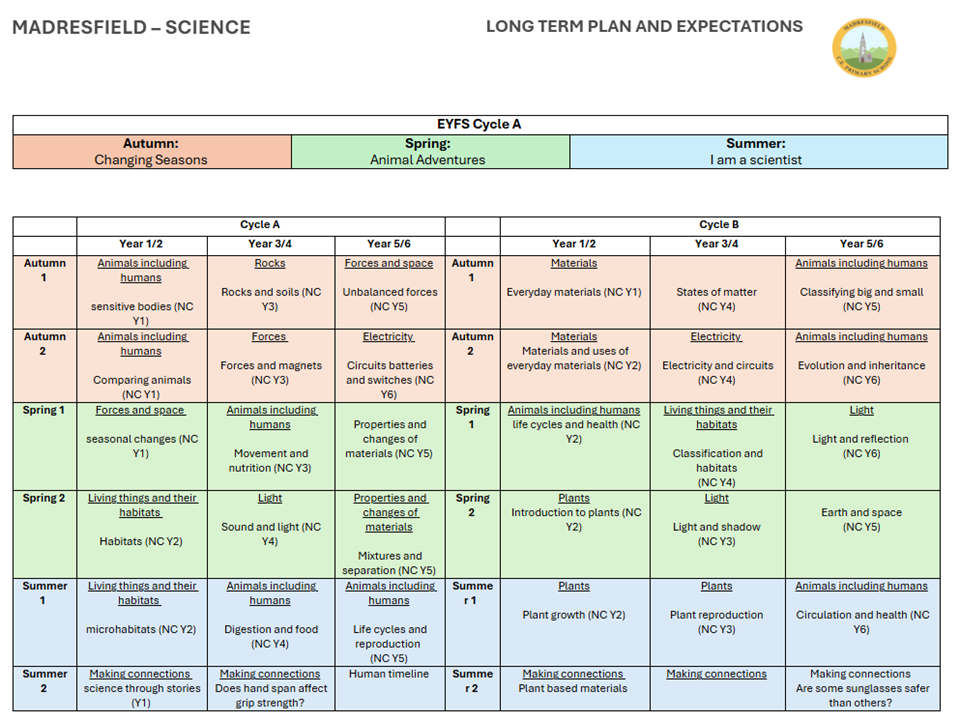
Key skills and progression - Kapow
Madresfield C.E. Primary School Awarded Primary Science Quality Mark
Primary Science Quality Marks have been awarded to 425 nursery, infant, junior, primary, middle, international and special schools this month to celebrate their commitment to excellence in science leadership, teaching and learning. So far, since its national launch in 2010, more than 5000 Primary Science Quality Marks (PSQM) have been awarded, creating a solid foundation of quality science education for over 1,000,000 children.
PSQM is a comprehensive evidence-based professional development programme that effectively develops science leadership, ensuring teachers have the knowledge, capability and support they need to transform science education and shape future generations.
The Primary Science Quality Mark is led by the University of Hertfordshire.
Helen Sizer, PSQM Co-Director said: ‘By enabling effective science leadership, PSQM is powering the potential of all children to see the relevance and importance of science in their lives, now and in the future. Schools that have achieved a Primary Science Quality Mark have demonstrated a significant commitment to science leadership, teaching and learning and the profile and quality of science in each accredited school is very high. Science subject leaders, their colleagues, headteachers, children, parents and governors should be very proud.”