Madresfield CofE Primary School

Maths
‘Obvious’ is the most dangerous word in mathematics.' Eric Temple Bell
What would the world be without the ability to reason and problem solve? Without the ability to count? Without the ability to earn money. Without numbers we have no certainty, we have no way of sustaining an independent life.
With a curriculum that is built with the purpose of automatic retrieval, we provide our children with a platform to use their numbers quickly and effortlessly so that they have capacity to be creative with pattern spotting and problem solving. By empowering children to think logically we open their world up to a right and wrong and the satisfaction that that can bring
Madresfield's map to proficient mathematicians
The first steps to becoming a successful mathematician:
- Pattern spotting
- Recalling number facts
- Use concrete resources to support understanding
I am 4 and I'm in EYFS. Numbers are so important to me. I love to count! How old will I be on my next birthday? How many sleeps until my next exciting adventure? How many beans are on my plate? How many presents have I got? How many minutes until bed time? I love singing number songs, I love hearing about the 3 little pigs and the 3 bears who ate Goldilock's porridge!
I can:
- count objects including saying the numbers in order and matching one number name to each item.
- estimate and guess how many there might be before counting.
- look at small quantities in familiar patterns – for example a dice saying how many I can see.
- use 5 frames and 10 frames.
- explore the composition of numbers to 10
- automatically recall number bonds for numbers 0-5/0-10.
- use vocabulary ‘more than’, ‘less than’, ‘fewer’, ‘the same as’, ‘equal to’.
- Understand the ‘one more than/one less than’ relationship
- Count beyond 10, noticing patterns within the structure of counting.
- Select, rotate and manipulate shapes in order to develop my spatial reasoning skills.
- Compare length, weight and capacity.
- Continue, copy and create repeating patterns.
I am In KS1 now, I am starting to learn bigger numbers, did you know I can count up to 100 now? Numbers are still exciting, I can spot patterns. I'm not afraid to make mistakes now, this is how I learn.
I can:
- Use 10s frames to explain place value
- Use base 10, double sided counters etc to solve addition, subtraction, multiplication and division calculations
- Use bar models and place value charts to represent number
- Use jottings to support my calculations
- Automatically recall number bonds and related facts
- Spot my mistakes with support and try to correct them
- Demonstrate I am familiar with two digit numbers and am starting to notice patterns within them.
- Recall odd and even numbers
- Use mathematical language when explaining how I solved a problem
- Use arrays to show my understanding of early division and multiplication skills
- Count in 2s, 5s and 10s
- Discuss the properties of 2D and 3D shape
- Compare 2D and 3D shapes using my knowledge of the properties of shapes
- Compare length, weight and capacity and use my knowledge to solve real life problems
KS2 and who knew that numbers could get so big, counting up to 100 is a thing of the past. I've spent years counting to ten million - I don't recommend doing it all at once!
I can:
- Fluently recall the four operations (addition, subtraction, multiplication and division)
- Solve a range of problems (including using decimals and fractions)
- Make connections with number and measure
- Draw shapes with increasing accuracy
- Analyse shapes and properties
- Recall times tables up to 12x12
- Use measure instruments with increasing accuracy
- Read and spell mathematical vocabulary
It's time for new adventures, Year 7 awaits. Larger numbers, quicker strategies and more opportunities to be creative with numbers. I am a mathematician and there's more than right or wrong, the answer is just the beginning!
Our Vision and Principles
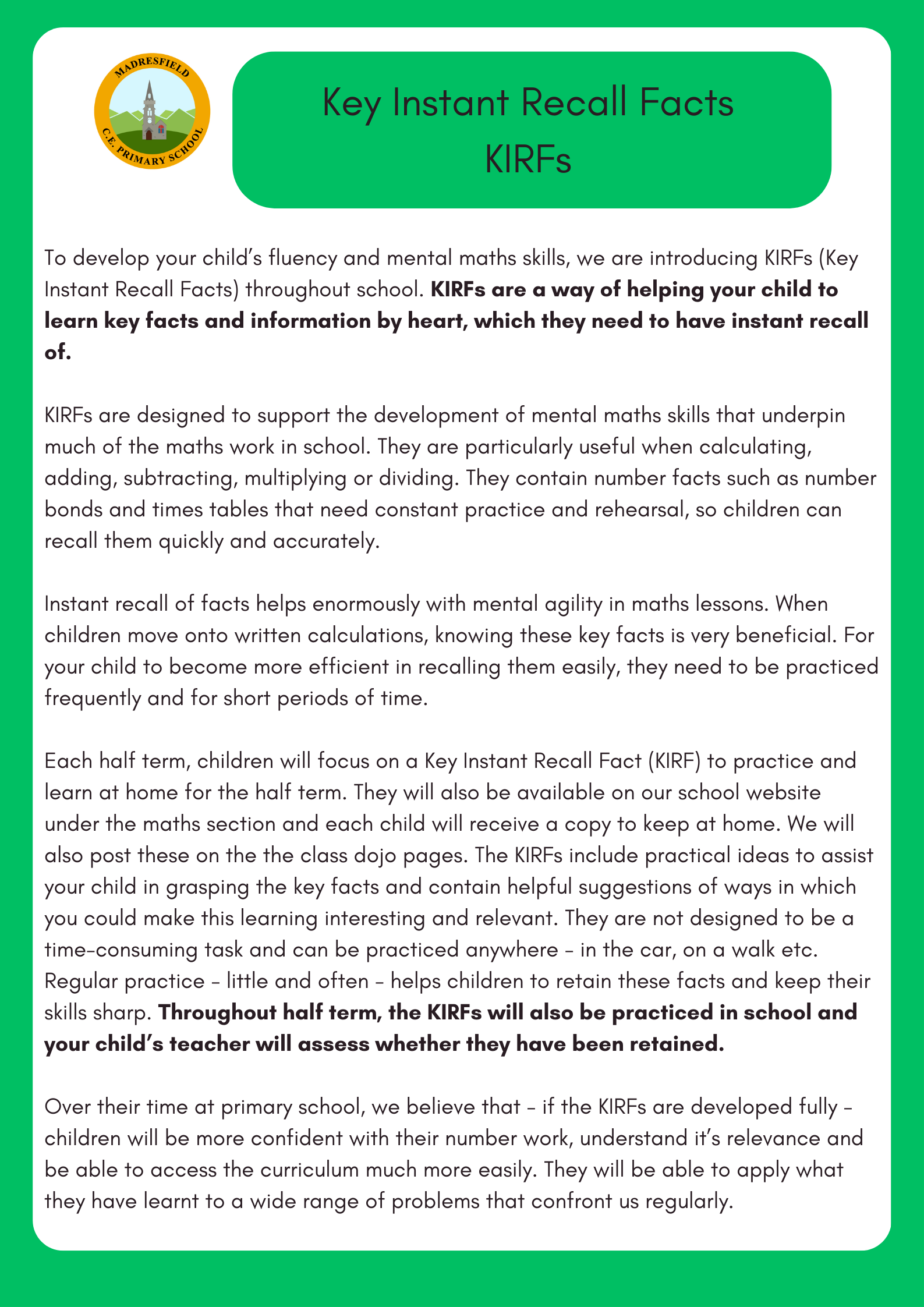
Maths Calculation Policy
TTRS - Practice your times table, challenge each other and compete to get a rock star status! Individual login required - please speak to your child's class teacher. Year 2 to Year 6!
Numbots - practice your fluency of number, gain coins and creating your own personalised robot. Suitable from EYFS up. Individual login required - please speak to your child's class teacher.
Top Marks - have a range of games available related to many areas of maths! Get exploring!
Topmarks: teaching resources, interactive resources, worksheets, homework, exam and revision help
Nrich - offer maths support, problem solving activities and practical games to play at home and at school.